
Prepare non-HAZWOPER employees to judge whether a chemical spill is incidental, then clean it up safely with the right PPE, absorbents and spill-kit tools.
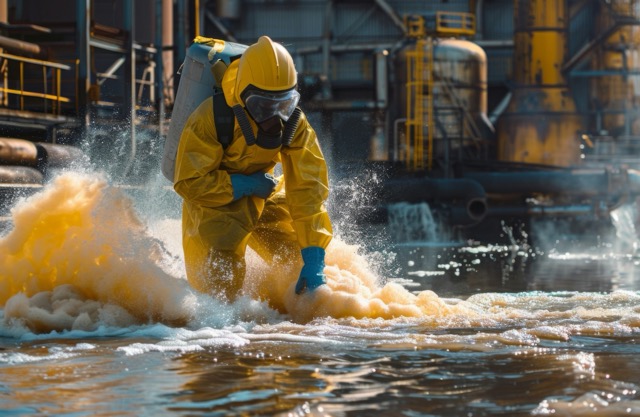
Most chemical spills in a facility are small and can be cleaned up safely by trained employees. The challenge is knowing when a release is routine and when it needs HAZWOPER-trained emergency responders. This course is for workers who are not HAZWOPER responders but may discover or clean up spills, leaks and releases. The program starts with what to do when you find a hazmat release and how to decide whether it is an emergency or an incidental release. It explains the step-across test for sizing up a spill and the actions to take when an event calls for HAZWOPER responders. For incidental releases, it walks through the cleanup steps, required PPE and the supplies typically stocked in a spill locker. Viewers see how to use loose absorbent, pads, pillows and socks, how to manage the resulting waste, and what to do after cleanup. OSHA's HAZWOPER standard, 29 CFR 1910.120, does not treat incidental releases controlled by employees in the immediate area as emergency response. The video runs about 19 minutes in English.
Non-emergency hazmat spill response training is for employees who handle chemicals but are not HAZWOPER responders, such as production, maintenance, warehouse and lab staff. Spill training helps them decide whether to clean up a small spill or call trained responders. The 19-minute English video also covers spill kit supplies.
Incidental chemical spills do not require HAZWOPER training under OSHA 29 CFR 1910.120. OSHA excludes small releases that employees in the immediate area can safely absorb, neutralize or control. Workers who clean them up still need hazard communication training under 1910.1200 and PPE training under 1910.132.
An incidental spill is a small, controllable release that poses no significant safety or health hazard to people nearby. An emergency release is larger, more dangerous or uncontrolled, and needs HAZWOPER-trained responders. When in doubt, treat a chemical spill as an emergency, evacuate and notify responders.
A chemical spill kit should hold absorbents in several forms, such as loose granules, pads, pillows and socks. Add PPE matched to the chemicals on site, plus disposal bags, labels, a scoop or brush and warning signs. Check and restock spill kits after every use.
Used absorbents from a chemical spill take on the hazards of the spilled material and may be hazardous waste. Place them in a compatible, closed container and label it with the contents. Follow your facility's waste procedures, then decontaminate tools and PPE before restocking the spill kit.
Schedule a demo with one of our reps
Our extensive Learning Management System allows you to dispatch knowledge and required certificates to teams across your site portfolio.
Our platform caters to all learning styles and scenarios, ensuring effective knowledge retention.
Take control of the learning experience with our configurable class structure. Tailor the training journey to match your organizational needs.
Deliver targeted safety training regimens at every level, putting safety directly into the hands of your workforce.


Deliver more than 400 online safety courses as well as your own training with the SafetyAmp learning management system.
Easily enroll employees into training courses, whether they're in a classroom or taken online - then visualize training history and compliance across multiple locations.
SCORM-compatible
Library of 400+ courses from partner training providers
Create online training courses
Quickly view employee training history
Schedule classroom training sessions
Manage training renewals
Eliminate lost certificates
Built-in reports for training compliance

Other Courses

Build confidence for critical moments through clear Hot Work Safety: Welding, Cutting, and Brazing instruction on frequent hazards associated with welding, cutting, and brazing.

Make workplace requirements clearer. Get a practical overview of spaces using OSHA’s three-pillar criteria for bodily entry in Confined Spaces: Acceptable Entry Conditions.

Give maintenance workers a clear six-step lockout/tagout routine, from identifying hazardous energy to verifying isolation before any work begins.


Made in the U.S.A.
© Copyright 2026