
Prepare authorized employees to lock out machines, drain stored energy, verify isolation and return equipment to service under OSHA 1910.147.
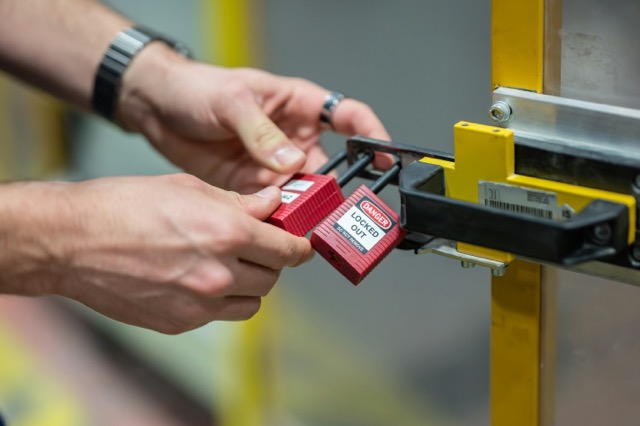
Lockout/tagout procedures are critical for protecting authorized workers who service and maintain machinery and equipment with hazardous energy sources. This comprehensive training program covers the OSHA requirements for authorized employees who perform lockout/tagout procedures to control hazardous energy during maintenance, servicing, and repair work. Participants will learn the specific responsibilities of authorized employees under OSHA's lockout/tagout standard, how to identify all energy sources (electrical, mechanical, hydraulic, pneumatic, chemical, thermal) that must be controlled, the step-by-step procedures for properly shutting down equipment and applying lockout/tagout devices, techniques for draining, relieving, or blocking stored or residual energy to achieve a zero-energy state, and verification procedures to ensure equipment is properly locked out before beginning work. The training also covers group lockout procedures when multiple workers are involved, how to safely remove locks and tags and return equipment to service, and the critical importance of never removing another worker's lock or bypassing lockout procedures. By following proper lockout/tagout procedures, authorized workers protect themselves and their coworkers from serious injuries and fatalities caused by unexpected equipment startup or energy release.
Authorized employee lockout/tagout training is required for workers who personally lock or tag out machines to service or maintain them. That typically includes maintenance mechanics, electricians, millwrights, setup technicians and some machine operators. The 13-minute video is available in English and Spanish.
OSHA's Control of Hazardous Energy standard, 29 CFR 1910.147, covers lockout/tagout in general industry. Employers must have a written energy control program, machine-specific procedures, training and periodic inspections. Authorized employees must be trained to recognize hazardous energy sources and the methods for isolating and controlling them.
In lockout/tagout, authorized employees are the only workers permitted to apply locks and tags and service equipment under lockout. Affected employees operate or work near the equipment being locked out but do not apply the lockout. Affected employees must understand its purpose and never try to restart locked equipment.
OSHA sets no fixed calendar for lockout/tagout retraining. Authorized employees must be retrained when job duties, machines, processes or procedures change. Retraining is also required when the periodic inspection, done at least annually, reveals gaps in knowledge. Many employers still refresh authorized employees every year.
The basic steps to lock out a machine start with preparing and notifying affected employees. Then shut the machine down, isolate every energy source, and apply locks and tags. Next, release or block stored energy. Finally, verify isolation by trying to start the machine before beginning work.
Schedule a demo with one of our reps
Our extensive Learning Management System allows you to dispatch knowledge and required certificates to teams across your site portfolio.
Our platform caters to all learning styles and scenarios, ensuring effective knowledge retention.
Take control of the learning experience with our configurable class structure. Tailor the training journey to match your organizational needs.
Deliver targeted safety training regimens at every level, putting safety directly into the hands of your workforce.


Deliver more than 400 online safety courses as well as your own training with the SafetyAmp learning management system.
Easily enroll employees into training courses, whether they're in a classroom or taken online - then visualize training history and compliance across multiple locations.
SCORM-compatible
Library of 400+ courses from partner training providers
Create online training courses
Quickly view employee training history
Schedule classroom training sessions
Manage training renewals
Eliminate lost certificates
Built-in reports for training compliance

Other Courses

Build confidence for critical moments through clear Hot Work Safety: Welding, Cutting, and Brazing instruction on frequent hazards associated with welding, cutting, and brazing.

Make workplace requirements clearer. Get a practical overview of spaces using OSHA’s three-pillar criteria for bodily entry in Confined Spaces: Acceptable Entry Conditions.

Give maintenance workers a clear six-step lockout/tagout routine, from identifying hazardous energy to verifying isolation before any work begins.


Made in the U.S.A.
© Copyright 2026