
Equip petroleum, industrial and emergency response workers to recognize hydrogen sulfide hazards, monitor the air and choose the right protective gear.
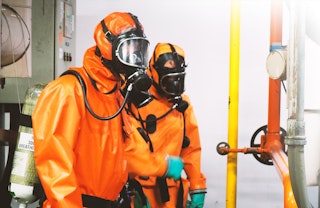
This critical safety training program addresses the extreme hazards of hydrogen sulfide (H2S), a highly toxic and potentially lethal gas commonly encountered in petroleum refining, natural gas production, wastewater treatment, pulp and paper mills, and other industrial operations. Hydrogen sulfide is particularly dangerous because it is both an asphyxiant that displaces oxygen and a chemical asphyxiant that interferes with cellular respiration, causing rapid unconsciousness and death at high concentrations. At very low levels (0.01-1.5 ppm), H2S has a characteristic 'rotten egg' odor, but at higher dangerous concentrations it paralyzes the olfactory nerves, eliminating the ability to smell it—a phenomenon called 'olfactory fatigue' that provides a false sense of safety. Petroleum workers, wastewater operators, and industrial personnel will learn to recognize the physical and chemical properties of hydrogen sulfide, including its density (heavier than air, accumulating in low areas), flammability range, and toxicity at various concentrations. At 10-50 ppm, H2S causes eye and respiratory irritation. At 100-500 ppm, exposure causes pulmonary edema, confusion, and loss of reasoning. Above 500 ppm, hydrogen sulfide causes immediate unconsciousness, respiratory paralysis, and death within minutes. The course covers comprehensive protective measures including atmospheric monitoring with calibrated H2S detectors, alarm systems and action levels, engineering controls such as ventilation systems, and mandatory use of appropriate respiratory protection including airline respirators or SCBA for entry into H2S atmospheres. Participants learn proper selection and use of personal protective equipment, buddy system requirements, and emergency rescue procedures that prevent would-be rescuers from becoming victims themselves. Additional training topics include work permit systems for H2S environments, evacuation procedures when alarms activate, emergency response protocols including victim rescue and medical treatment, decontamination procedures, and the critical importance of never entering an H2S atmosphere without proper equipment and authorization. This life-saving training ensures workers understand the deadly nature of hydrogen sulfide and the protective measures necessary to work safely in environments where H2S may be present.
Hydrogen sulfide safety training is for workers who may encounter H2S on the job. That includes petroleum refinery and natural gas personnel, wastewater operators, and pulp and paper mill employees. Emergency responders who may face H2S releases or fires also need it. The 36-minute video is available in English.
OSHA regulates hydrogen sulfide exposure through its air contaminant limits in 29 CFR 1910.1000, Table Z-2. That table sets a 20 ppm ceiling for general industry. When respirators are needed, the respiratory protection standard, 29 CFR 1910.134, applies. Permit-required confined spaces with H2S also fall under 29 CFR 1910.146.
You can't rely on smell to detect hydrogen sulfide because higher concentrations quickly deaden the sense of smell. At low levels H2S smells like rotten eggs, but olfactory fatigue can make the odor seem to vanish while exposure is still dangerous. Calibrated gas detectors are the only reliable warning.
Hydrogen sulfide exposure symptoms depend on concentration. Low levels irritate the eyes, nose, and throat. Higher levels cause headache, dizziness, confusion, and fluid in the lungs. Above roughly 500 ppm, H2S can cause sudden collapse, stopped breathing, and death within minutes. Victims need fresh air and medical care immediately.
In an H2S fire, an offensive strategy means responders move in to control the source, such as closing a valve. They must wear SCBA and protective clothing. A defensive strategy keeps responders at a safe distance to protect exposures and isolate the area. Burning hydrogen sulfide also produces toxic sulfur dioxide.
Schedule a demo with one of our reps
Our extensive Learning Management System allows you to dispatch knowledge and required certificates to teams across your site portfolio.
Our platform caters to all learning styles and scenarios, ensuring effective knowledge retention.
Take control of the learning experience with our configurable class structure. Tailor the training journey to match your organizational needs.
Deliver targeted safety training regimens at every level, putting safety directly into the hands of your workforce.


Deliver more than 400 online safety courses as well as your own training with the SafetyAmp learning management system.
Easily enroll employees into training courses, whether they're in a classroom or taken online - then visualize training history and compliance across multiple locations.
SCORM-compatible
Library of 400+ courses from partner training providers
Create online training courses
Quickly view employee training history
Schedule classroom training sessions
Manage training renewals
Eliminate lost certificates
Built-in reports for training compliance

Other Courses

Build confidence for critical moments through clear Hot Work Safety: Welding, Cutting, and Brazing instruction on frequent hazards associated with welding, cutting, and brazing.

Make workplace requirements clearer. Get a practical overview of spaces using OSHA’s three-pillar criteria for bodily entry in Confined Spaces: Acceptable Entry Conditions.

Give maintenance workers a clear six-step lockout/tagout routine, from identifying hazardous energy to verifying isolation before any work begins.


Made in the U.S.A.
© Copyright 2026