
.jpg)
Most Safety Directors have never calculated what manual SDS management actually costs. When you do the math — labor, compliance exposure, emergency risk, and injury liability — the number is rarely under six figures.
The expense doesn't show up on one invoice. It's scattered across hundreds of small moments: the hour spent chasing a manufacturer for an updated sheet, the unlabeled spray bottle that becomes a citation, the three minutes a supervisor spends flipping through a binder while a worker waits with chemical on their skin.
This article puts a real number on each of those moments — and shows what a modern SDS management platform changes.
EHS staff managing SDS binders manually spend a minimum of 3 hours per week on the process: contacting manufacturers for updated sheets, printing, filing, pulling obsolete documents, and auditing binder accuracy. That's a conservative figure. Facilities with large chemical inventories often report 250 to 300 hours annually.

At a fully burdened EHS Manager rate of $61 to $77 per hour — median salary $95,000 to $121,000 plus benefits and overhead — those 156 hours cost $9,500 to $12,000 per year at a single facility. A five-site operation crosses $50,000 before accounting for a single fine or injury.
The more important question isn't what the labor costs. It's what it displaces. Every hour spent managing paper is an hour not spent on hazard identification, safety training, incident investigation, or building the safety culture that actually prevents injuries. OSHA estimates that every $1 invested in proactive safety returns $4 to $6 in reduced injury costs. Manual SDS administration is the opposite of proactive safety.
OSHA's Hazard Communication Standard at 29 CFR 1910.1200(g)(8) requires that SDS documents be "readily accessible during each work shift to employees when they are in their work area(s)."
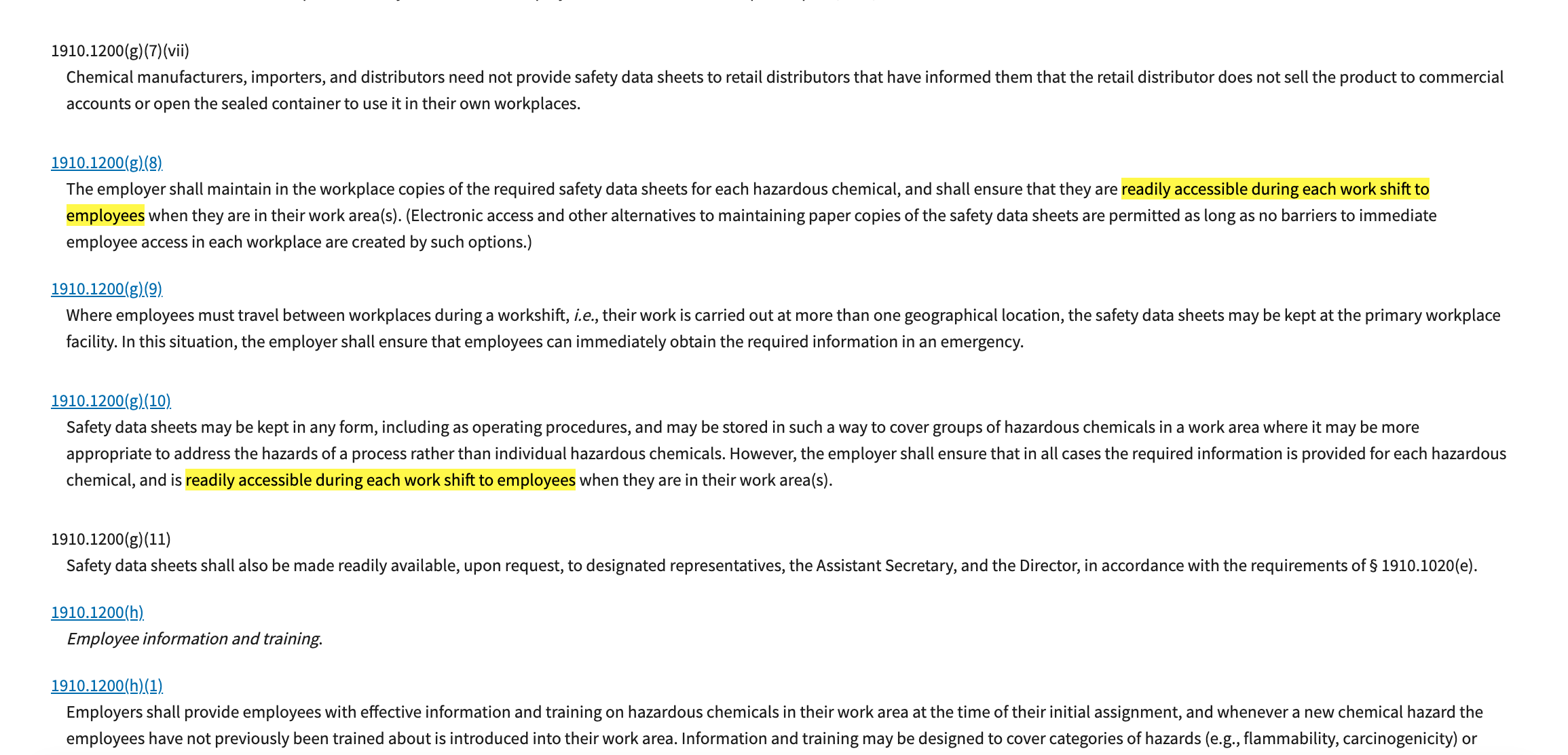
OSHA has been explicit about what "readily accessible" means. A 1999 interpretation letter states that it means immediate access — and explicitly rejected a proposed 2-hour retrieval window as non-compliant. A separate interpretation adds that SDS "must be available to employees without having to ask," meaning any system requiring a supervisor to unlock a cabinet or retrieve a binder is a violation by design.
Paper binders fail this standard in predictable ways. Sheets get misfiled or removed. Binders locked in offices or stored in separate buildings create physical barriers. Workers unfamiliar with filing conventions waste critical minutes searching. And during a chemical emergency — the moment when SDS access matters most — a binder in the affected area may be inaccessible or destroyed.
Hazard Communication has ranked as the #2 most-cited OSHA standard for three consecutive years, with 2,888 violations in fiscal year 2024. Facilities running manual programs aren't beating those odds.
OSHA's 2025 penalty schedule, effective January 15, 2025:
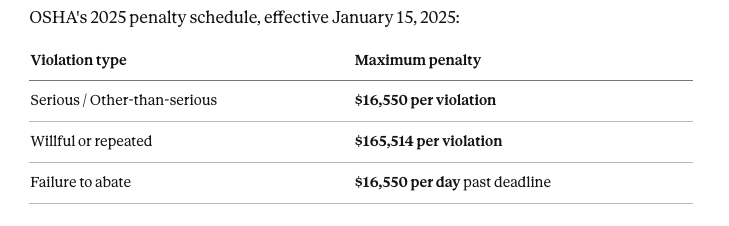
The compounding effect is what makes this dangerous. Each missing, outdated, or inaccessible SDS can be cited as a separate violation. Each unlabeled secondary container is its own citation. A facility with twelve improperly labeled spray bottles isn't facing one fine — it's facing twelve, potentially totaling $198,600 from a single inspection.
Real precedent: a metal coatings facility received 21 violations and $573,000 in proposed penalties, with SDS failures among the deficiencies cited.
Secondary container labeling creates a cascading risk. OSHA requires either full GHS label elements or a simplified workplace label — but the simplified option is only permissible when the full SDS is immediately accessible. Outdated SDS documents flow directly into incorrect container labels, which then constitute their own separate violations. Unlabeled secondary containers are consistently the most frequent HazCom violation inspectors cite.
Chemical manufacturers must update Safety Data Sheets within 3 months of new hazard information — new toxicology data, formula changes, regulatory reclassifications. Industry data shows that SDS libraries receive over 20,000 new or updated documents every week across the chemical industry.
For paper systems, this creates a structural compliance gap. A binder audit completed in January is potentially non-compliant by March. Worse, suppliers aren't required to proactively push updates. OSHA only requires the updated SDS accompany the first shipment after the revision, meaning organizations must proactively monitor and request updates — a task that's unmanageable at scale without software.
Research suggests the problem is widespread: only 40% of chemicals on-site typically match current SDS records at facilities relying on manual processes.
SafetyAmp monitors for SDS revisions automatically and updates your binders without anyone having to ask. With access to 22M+ safety data sheets across 7M+ unique CAS numbers, the database covers the chemical inventories of virtually every manufacturing operation.
For manufacturers running multiple facilities, manual SDS complexity doesn't scale linearly — it compounds. Every additional location multiplies the need for version control, consistent chemical inventories, update distribution, and audit readiness.
A manufacturer with 20 locations managing 500 chemicals per site, where 20% of SDS documents are updated annually, generates 2,000 individual update transactions per year — just for binder maintenance. Multiply by three to five binder stations per facility and the actual touchpoints can exceed 10,000 per year.
One well-documented case: Con Edison's manual chemical management process required 60 people. After moving to digital SDS management, one person handles the equivalent work.
Common failures in multi-site manual programs include fragmented repositories, lack of enterprise-wide compliance visibility, and the inability to prove during an audit that every location has current SDS for every chemical in use.
SafetyAmp lets each location build and manage its own site-specific SDS binder from a company-approved chemical list. Safety Directors get a single dashboard showing chemical inventory and compliance status across every facility. The library is standardized; the binders are site-specific.
Alkaline chemicals can penetrate the anterior chamber of the eye within 15 seconds of contact. Delaying irrigation by as little as 5 to 15 minutes can cause irreversible intraocular damage. Proper irrigation within the first 10 minutes reduces the risk of permanent vision loss by up to 90%.

In a paper binder system, locating the correct SDS requires finding the right binder, searching through hundreds of multi-page documents, and navigating to Section 4 (First-Aid Measures) buried in a 16-section document. Industry practitioners describe this as taking several minutes under calm conditions — far longer under the stress of an actual chemical emergency.
The United States sees over 36,000 emergency department visits annually from chemical eye burns, with permanent vision loss occurring in 15 to 20% of severe cases.
The financial exposure from a single burn injury, using OSHA's Safety Pays calculator:
At a 3% profit margin, a manufacturer needs $3.3 million in additional revenue to offset a single burn injury. Severe chemical burn claims can exceed $10 million and occasionally surpass $15 million per individual, according to NCCI workers' compensation data.
SafetyAmp gives every worker mobile access to the full SDS library from their phone. Search by product name, CAS number, or hazard class. The sheet is there in seconds — along with first-aid measures, PPE requirements, and spill response procedures.
Secondary container labeling is a quiet cost center that manual programs consistently handle poorly. OSHA requires that every secondary container display the product name and hazard information. Creating labels manually means pulling classification data from the SDS, formatting it correctly, printing, and then repeating the process every time the underlying SDS is revised.
Unlabeled or incorrectly labeled containers are the most frequently cited HazCom violation OSHA inspectors find. The citation risk is real, and the injury risk is worse — workers handling improperly labeled containers don't know what they're working with.
SafetyAmp generates secondary container labels directly from the SDS, with HMIS ratings built in. The label is accurate because it's sourced from the same document the library tracks. Revisions to the SDS flow automatically to updated label templates.
OSHA published its final rule updating the Hazard Communication Standard on May 20, 2024, aligning with GHS Revision 7. Compliance deadlines are staggered:
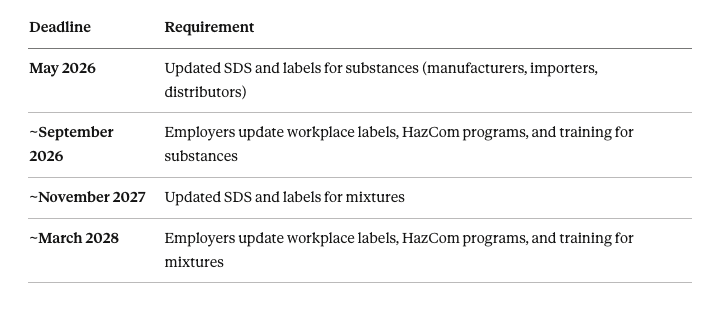
Key changes include a new hazard class for desensitized explosives, expanded flammable gas categories, and revised requirements across SDS Sections 2, 3, 9, and 11. OSHA estimates the rule affects over 1.5 million employees across more than 147,000 establishments.
For manufacturers running manual SDS systems, these deadlines add significant burden. Every sheet in inventory must be evaluated against updated classification criteria. Paper-based systems have no mechanism to flag which documents have been updated to GHS Revision 7 versus which remain under the old HCS 2012 framework — creating a tracking problem that manual processes simply can't solve at scale.
Software-managed libraries receive manufacturer-issued updates automatically. The transition is tracked by the system, not by staff.
Aggregating every cost category for a mid-size single-site manufacturer with a 200-chemical inventory:
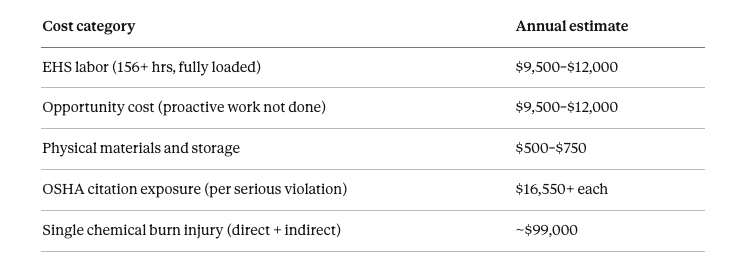
For a five-site manufacturer with 500+ chemicals, at least one citation, and the statistical probability of one chemical injury per year, total annual exposure clears $150,000 without a single willful violation or severe incident. One severe burn claim can push it past $1 million.
Companies that switch to digital SDS management consistently report 40% reductions in administrative time and dramatically lower injury rates. Verdantix research found organizations using EHS software for over five years achieve an average ROI of 239%.
SafetyAmp's SDS management module addresses each cost driver directly:
Database access. 22M+ safety data sheets from thousands of manufacturers. Building a complete site binder takes minutes, not days.
Automatic updates. SafetyAmp detects revisions and updates binders automatically. No one has to monitor manufacturer websites or chase suppliers.
Mobile access. Every worker can pull up any SDS from their phone in seconds — by product name, CAS number, or hazard class. No binder required.
Site-specific binders. Each location manages its own chemical inventory from a company-approved list. Standardization and flexibility, simultaneously.
Multi-site analytics. Track chemical inventories, compliance status, and SDS currency across every location from a single dashboard.
Container label generation. Print secondary container labels directly from the SDS, with HMIS ratings built in. Labels stay accurate as sheets are revised.
HazCom compliance. Meet OSHA's "readily accessible" requirement on every shift, at every location, without locked cabinets or manual retrieval.
SafetyAmp bundles SDS management inside a broader EHS platform — the same system that handles incident reporting, audits, training, corrective actions, and contractor management. One platform. One source of truth.
What is safety data sheet management software?
SDS management software stores, organizes, updates, and provides employee access to safety data sheets digitally. It replaces paper binders with a searchable, centralized library that stays current automatically.
How often do safety data sheets get updated?
Chemical manufacturers must update SDS within 3 months of new hazard information. With over 20,000 SDS documents updated weekly across the industry, tracking revisions manually at scale is practically unworkable.
What are the OSHA fines for HazCom non-compliance in 2025?
As of January 15, 2025: up to $16,550 per serious violation, and up to $165,514 per willful or repeated violation. Each missing or outdated SDS can be cited separately.
Is manual SDS management OSHA compliant?
It can be, but OSHA's "readily accessible" requirement is harder to meet than most facilities realize. Immediate access — without asking a supervisor, without unlocking a cabinet — is the standard. Paper systems frequently fall short.
Does SafetyAmp work for multi-site manufacturers?
Yes. Each location maintains its own site-specific SDS binder while pulling from a company-approved chemical list. Compliance visibility and analytics are available across all sites from a single dashboard.
What's changing with HazCom in 2026?
OSHA's HazCom 2024 update (GHS Revision 7) requires updated SDS and labels for substances by May 2026, with employer compliance for workplace labels and training following shortly after. Mixture deadlines run through 2028.
SafetyAmp is an EHS software platform built for multi-site manufacturing operations. To see the SDS management module in action, book a demo.


Made in the U.S.A.
© Copyright 2026